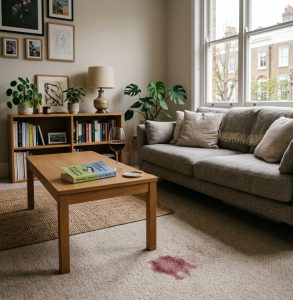

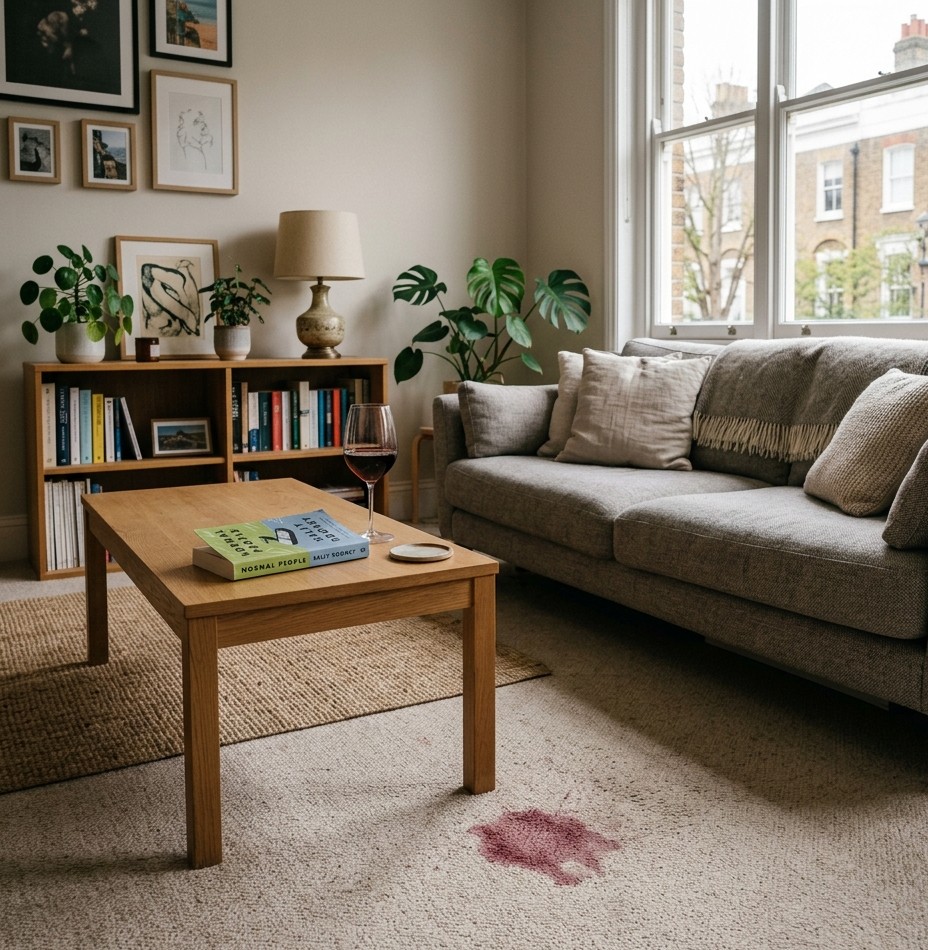
A dinner party is in full flow – the conversation is brilliant, the food is good, someone has just made a slightly too-enthusiastic point about something, and a full glass of Merlot has introduced itself to your carpet. Within approximately four seconds, at least two guests will have suggested salt. Someone will already be heading to the kitchen. The salt will arrive, be deployed with the confidence of someone who has seen this work before, and the room will briefly feel as though the situation is under control.
This is one of the most enduring rituals in British domestic life. The salt method for wine spills is handed down through generations with the quiet authority of established fact – right there alongside “feed a cold, starve a fever” and “put butter on a burn.” But how much of it is actually grounded in science, and how much is the collective comfort of doing something that looks convincing in a crisis? It is a question worth answering properly – particularly if the carpet in question is one you would rather keep.
What the Salt Method Actually Involves
For the uninitiated, the method goes like this: immediately after a red wine spill, pour a generous quantity of table salt directly onto the wet stain. The salt is supposed to draw the wine up and out of the carpet fibres through absorption, preventing it from setting. Leave it for a few minutes – or longer, depending on who is advising you – then brush or vacuum it away. Some variations involve blotting first; others go straight to the salt. A few particularly committed advocates recommend following up with white wine, which raises questions of its own.
The appeal is obvious. It is immediate, accessible, and satisfyingly decisive. Salt is in every kitchen. The action of pouring it feels purposeful. And the moment it starts turning pink, you feel as though something useful is definitely happening.
The Science – What Salt Is Actually Doing
Here is where things get interesting – because salt is not entirely without merit. It is hygroscopic, meaning it actively attracts and absorbs moisture from its surrounding environment. More relevantly, it creates a modest osmotic effect: dissolved particles tend to move from areas of lower concentration toward higher concentration, which means the liquid in the carpet fibres has a theoretical incentive to travel toward the salt rather than deeper into the pile.
In practice, this means the salt is genuinely doing something. It is absorbing some of the liquid content of the spill, which limits – to a small degree – how much wine continues to penetrate the fibres. Applied immediately to a very fresh, very surface-level spill, it will capture a portion of the moisture. There is real chemistry here, and dismissing the method as complete nonsense would be unfair.
The problem is that absorbing liquid and removing a stain are two entirely different things. Red wine’s staining power does not come from its moisture content. It comes from tannins and anthocyanins – the deeply pigmented compounds responsible for its colour – which bond to carpet fibres almost immediately upon contact. Salt does nothing to these compounds. It does not break them down, dilute them chemically, or lift them from the fibre. It absorbs the water those pigments are travelling in, but the pigments themselves are largely unimpressed by the whole arrangement.
Why the Myth Has Staying Power
The salt method has the considerable advantage of being visually persuasive. You pour it on, you watch it turn red, and the brain quite reasonably interprets this as “the wine leaving the carpet.” Confirmation bias does the rest. Something is visibly happening, and that is usually enough.
There is also the question of timing. The salt method is almost always applied immediately – which means it coincides with the most important window for dealing with any liquid spill: the first thirty seconds, when the stain is still entirely on the surface and proper blotting would be most effective. When the carpet is subsequently less stained than feared, the salt gets the credit. The rapid response gets none.
And then there is the social dimension. A dinner party wine spill is a minor crisis with an audience, and doing something – anything – with conviction is psychologically preferable to kneeling quietly on the carpet with a sheet of kitchen roll. Salt has theatre. It has presence. It arrives in a meaningful quantity and gets poured with authority. It is, in essence, the cleaning equivalent of a confident-sounding person at a meeting who may not actually know what they are talking about but sounds terrific in the moment. The room feels calmer. That counts for something.
The Real Enemy – What Red Wine Is Actually Doing to Your Carpet
To understand why salt falls short, it helps to know what you are genuinely up against. Red wine contains anthocyanins – pigment molecules responsible for its colour that have a strong affinity for the fibres found in most carpets, particularly wool and nylon. These molecules begin bonding to the fibre surface almost immediately upon contact, and once that bond sets, you are no longer dealing with a surface stain but with something that has become, at a molecular level, part of the carpet.
Heat accelerates this process considerably, which is why warm water, a warm cloth, or any steam applied to a fresh wine stain is a serious mistake that many people make with the best of intentions. Warmth opens up carpet fibres and actively invites the anthocyanins deeper in. Cold is always your first and most important ally.
Tannins add a further complication. These compounds, also present in red wine, act as a secondary staining agent and are particularly resistant to simple water-based treatments. They respond well to oxidising agents – which explains why certain commercial stain removers have a meaningfully better effect on wine than plain water, and why sparkling water, though not magical, has some marginal advantage over still.
What Actually Works – The Proper Protocol
If salt is not the hero of this story, what is? The honest answer is that speed and correct technique matter far more than any particular product.
The moment a spill occurs, blot it. Use a clean white cloth or kitchen roll, pressing firmly and lifting rather than rubbing. Rubbing drives the stain deeper and spreads it wider – two things to avoid at all costs. Work from the outside edge inward to contain the spread. Cold water applied sparingly and blotted repeatedly will dilute the wine and lift a significant proportion of it from the surface before setting begins.
Once the excess liquid is removed, bicarbonate of soda spread over the damp area will absorb remaining moisture and create a mild alkaline environment that helps lift residual pigment. Leave it to work, then vacuum thoroughly. For anything that remains, a specialist carpet stain remover containing oxidising agents – hydrogen peroxide-based formulations are particularly effective on wine – will target the anthocyanins directly in a way that salt simply cannot.
One important caveat: always test any product on an inconspicuous area first. Natural fibre carpets, in particular, can respond unpredictably to even mild chemical treatments, and the last thing you want after a wine incident is a bleached patch where the stain used to be. Wool carpets are especially susceptible, and anything hydrogen peroxide-based should be approached with particular caution on them.
The Verdict – an Urban Legend With a Grain of Truth
The salt method is not pure fiction. It genuinely does absorb moisture and may slow the wine’s initial penetration of the fibre – which is not nothing. But it addresses the carrier rather than the stain, and in doing so it has spent decades receiving credit that rightfully belongs to the speed of the response rather than to the salt itself.
Think of it as a moderately useful first instinct that has been considerably oversold. If salt is what is to hand and applying it stops someone from reaching for hot water or scrubbing aggressively with a tea towel, it has served a genuine purpose. The absorption is real; the stain removal is largely illusory. But if it delays a proper blotting response because everyone is too busy watching the crystals turn pink, it may have made things worse. It is, at best, a placeholder – not a solution.
When the Damage Is Already Done
For stains that have been through the salt treatment, the hot water treatment, and perhaps several other well-intentioned interventions before anyone thought to reach for something appropriate – or for anything that has had time to set – professional hot water extraction with targeted pre-treatment is the most reliable option available.
Set wine stains that have fully bonded to the fibre require enzyme treatments and oxidising agents applied under professional conditions to achieve meaningful results. Surface cleaning, however diligent and thorough, will not reach a stain that has embedded itself deep into the pile and dried there. Red wine is one of the most common reasons London households request a professional carpet clean, and in the vast majority of cases the stain has already been through at least one round of home treatment by the time the call is made. The sooner a professional sees it, the better the likely outcome tends to be – salt, bicarbonate of soda, white wine, and all.