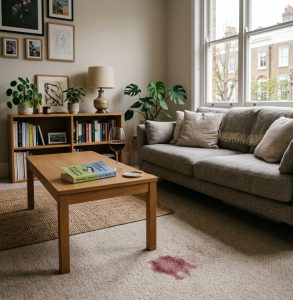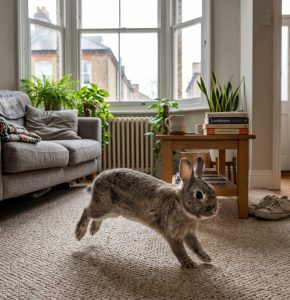

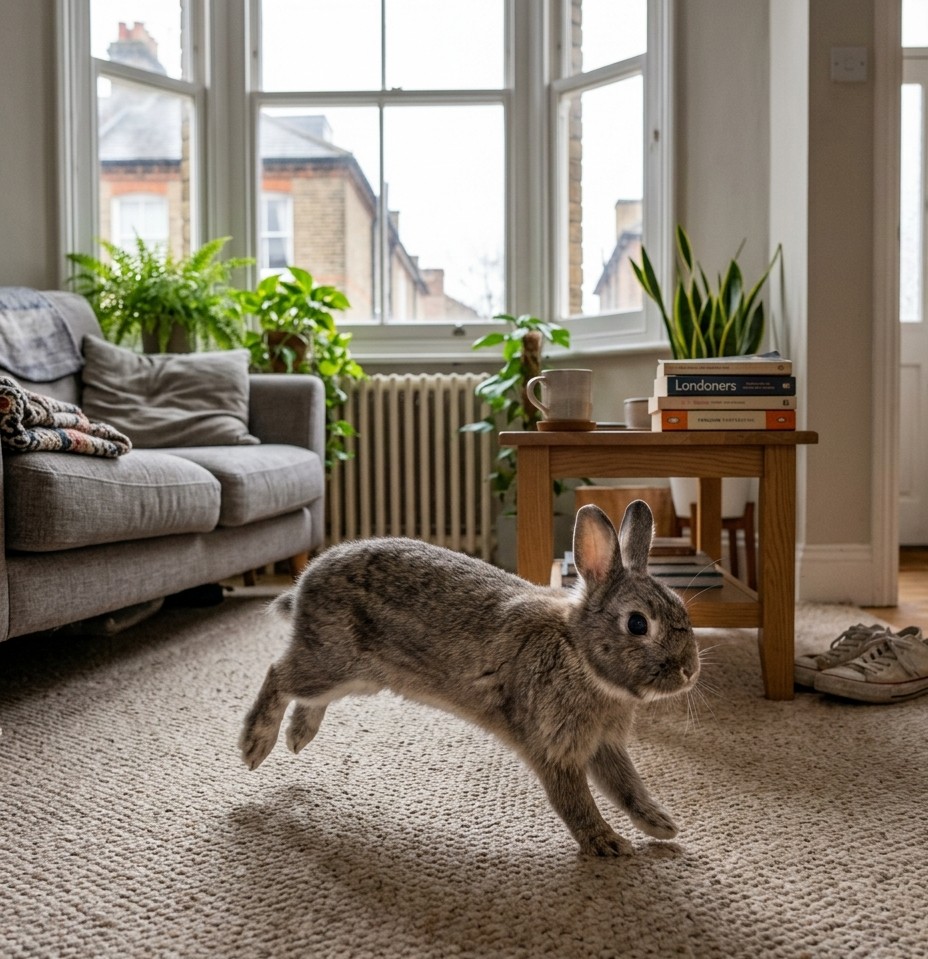
There is a very specific moment that every free-range rabbit owner knows. You’ve been sitting on the sofa watching telly, your rabbit has been doing laps of the living room with the confident energy of someone who pays the mortgage, and then you glance down. There, arranged across your carpet with the casual indifference of a creature who has never once considered consequences, is a scattering of droppings tracing your bunny’s entire evening route like a very unpleasant breadcrumb trail. Welcome to the free-range lifestyle – in its full, unedited glory.
Here’s the thing, though: rabbit droppings are, by the standards of pet-related carpet disasters, relatively civilised. They are not cat sick. They are not a muddy Labrador. With the right approach, a rabbit dropping incident on carpet is entirely manageable – and in most cases, entirely reversible. The key phrase is “right approach,” because getting it wrong can transform a five-minute tidy-up into a weeks-long odour problem and a stain that outlasts the furniture.
Know Your Enemy – What Rabbit Droppings Actually Are
The Two Types You’ll Encounter (Yes, Two)
Before reaching for any cleaning product, there is one important piece of rabbit biology worth understanding – because not all rabbit droppings are equal, and the distinction has a direct bearing on how you clean them.
The familiar type are hard, dry fecal pellets – small, round, low in moisture, and mercifully close to odourless. These are what most owners encounter on their carpets. The second type are caecotropes – soft, clustered, grape-like cecal pellets that rabbits normally consume directly from their hindquarters as part of digestion. If your rabbit misses this step, a caecotrope on carpet is an entirely different proposition: sticky, pungent, and considerably less cooperative. Misidentifying one for the other and applying the wrong method is how a straightforward clean becomes a lasting problem. A few seconds of proper assessment before doing anything else is time very well spent.
First Response – What to Do in the Immediate Aftermath
Dry Pellets: Don’t Panic, Just Pick Up
If you are dealing with dry rabbit pellets, the most important thing to know is this: do not introduce moisture yet. It sounds counterintuitive, because the instinct when faced with any mess is to grab a damp cloth and start wiping. Resist it. A dry pellet pressed into damp carpet fibres becomes a staining event. Leave it dry, and it remains a purely mechanical problem.
Remove the pellets by hand or with a stiff piece of card, gathering them carefully rather than pressing them deeper into the pile. A handheld vacuum on a low to medium setting handles the smaller pieces well. Once the solids are gone and you have vacuumed the area thoroughly, a fresh incident involving dry pellets is often resolved entirely at this stage – no further treatment required.
Soft or Squashed Droppings: The Trickier Customer
A caecotrope, or a pellet that has been sat on, trodden in, or has been sitting long enough to soften, is a different matter – and if you have made the discovery with bare feet at seven in the morning, you have our full sympathies.
Work from the outside of the affected area inward, scraping away solid material with a blunt knife or piece of card. Then blot – do not rub – with a clean white cloth and cold water. Cold is absolutely non-negotiable. Heat at this stage will begin to set the protein-based compounds into the carpet fibres, turning a temporary mess into a permanent stain. Blot, lift, rotate to a clean section of cloth, repeat. Patience here pays genuine dividends later.
The Deep Clean – Lifting Stains and Neutralising Odour
DIY Solutions That Actually Work
Once the bulk material is removed, the goal shifts to chemical breakdown – neutralising the uric acid, proteins, and bacteria that cause both staining and persistent odour.
A solution of one part white vinegar to two parts cold water is a reliable starting point. Apply it to the affected area, allow it to dwell for five to ten minutes, then blot dry. Follow with a generous layer of bicarbonate of soda spread over the damp patch to absorb residual moisture and odour as it dries. Leave it for at least twenty minutes – an hour is better – then vacuum thoroughly.
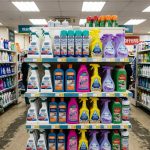
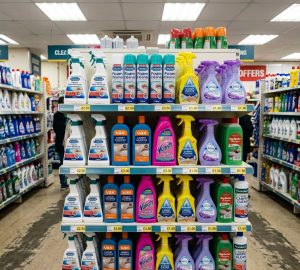
For anything beyond a very minor, very fresh incident, an enzyme-based cleaner is the product you actually want. These work by deploying biological enzymes that break down organic compounds at a molecular level – uric acid, proteins, bacteria – rather than masking them. They do not disguise the problem; they dismantle it. Pet-specific enzyme cleaners are widely available in supermarkets and online, and if you own a free-range rabbit and do not currently have one in your cleaning cupboard, that is worth rectifying.
Products to Avoid (and Why They Make Things Worse)
Bleach is the most common well-intentioned mistake. It does not neutralise uric acid effectively, it can permanently strip colour from carpet fibres, and it leaves a residue that reacts poorly with subsequent products. Leave it under the sink. Heavily perfumed sprays and fabric fresheners are, at best, a short-term cosmetic fix; at worst, they combine with the compounds in the dropping to produce an odour that is somehow more objectionable than the original. And applying steam or hot water in the early stages is counterproductive for exactly the same reason cold water matters: heat sets protein-based stains into carpet fibres with considerable efficiency, making later removal significantly harder.
When the Problem Is Bigger Than One Bunny Incident
Repeat Offending – Identifying a Favourite Spot
Rabbits are creatures of strong habit, and if your carpet has become a preferred toilet location, a single clean – however thorough – will not solve the problem on its own. The reason is scent. Organic residue, even after a conscientious clean, can remain detectable to a rabbit long after the area smells perfectly fine to every human in the household. That residual scent signals that this is an acceptable spot, the rabbit returns, and the cycle continues regardless of how diligently you clean.
A UV torch – inexpensive and widely available online – is a revelatory tool here. Under ultraviolet light, organic staining that is completely invisible in normal conditions fluoresces clearly, revealing the true extent of affected areas. Many owners are surprised by what they find. Once the problem is accurately mapped, thorough enzyme treatment of every affected zone becomes essential – because breaking the scent cycle is as important as addressing the visible staining.
Deep-Set Staining and Subfloor Contamination
Repeated incidents over weeks or months can push contamination beyond the carpet pile into the underlay beneath – and in more serious cases, into the subfloor itself. When this happens, surface cleaning becomes inadequate regardless of the products applied, because the source of the problem is no longer in the layer being treated.
The signs are consistent: a smell that returns persistently after cleaning, discolouration that reappears as the carpet dries, or a background mustiness that no amount of ventilation shifts. If these are present, the situation has moved beyond what domestic methods can reliably address.
Calling in the Professionals – What a London Carpet Cleaner Can Do That You Can’t
Hot Water Extraction vs. Standard DIY Methods
Professional carpet cleaning – specifically hot water extraction, frequently but inaccurately called steam cleaning – operates at a level that domestic equipment and hire machines cannot match. The process involves injecting a heated cleaning solution deep into the carpet pile under controlled pressure, then extracting it along with dissolved soiling, organic residue, and bacteria in a single thorough pass.
The differences that matter are penetration depth, precise water temperature control, industrial-grade enzyme pre-treatments, and raw extraction power. A hire machine leaves carpets significantly wetter than professional equipment, extending drying time, increasing the risk of mildew, and often redistributing contamination rather than removing it. A professional unit extracts the vast majority of moisture, meaning carpets are typically dry within two to four hours. For carpets with accumulated organic contamination from months of free-range activity, it is the most dependable route to a result that addresses the problem at every depth, not just at the surface.
Living With a Free-Range Rabbit – Prevention Without Sacrificing the Fun
Litter Training and Strategic Carpet Protection
The encouraging truth is that rabbits are more trainable than most people assume. Naturally inclined to use a single toilet location, they take well to litter training – typically a tray filled with hay that they will happily sit in while eating. With consistency and patience, it is achievable for the majority of bunnies and dramatically reduces the frequency of carpet incidents.
In the meantime, washable rugs or carpet runners over high-traffic bunny zones provide an easily laundered buffer. Positioning a litter tray in the spots your rabbit has already identified as preferred is often more immediately effective than attempting to redirect the behaviour from scratch. Working with the animal’s instincts rather than against them produces faster results – and considerably fewer mornings spent on your hands and knees with a bottle of enzyme cleaner.
Free-range rabbits bring a particular kind of joy that any owner will defend without much prompting, droppings and all. With the right knowledge, the appropriate products to hand, and an honest sense of when a problem has grown beyond what a DIY approach can solve, both the rabbit and the carpet can be kept in good order – occasionally, remarkably, at the same time.